
I did not wake up one day and decide to become a physical media collector.
It was more gradual than that.
For years, streaming made sense. It was easy, convenient and cheaper than buying every movie or series individually. You could open Netflix, Disney+, Prime Video or another service and usually find something to watch.
But over time, something started to feel wrong.
I was paying for more services, scrolling more, owning nothing, and still not always having access to the movies I actually wanted to watch.
That is one of the reasons I started buying Blu-rays again.
Not because I hate streaming. I do not. Streaming is still useful. But I am tired of renting access to entertainment forever without building anything of my own.
EddaVault starts from that idea:
Own your entertainment.
And for me, buying physical media again is one of the simplest ways to begin.
Streaming Is Convenient, But It Has a Problem
Streaming is good at one thing: convenience.
You open an app, search for a movie, press play and you are watching within seconds. When it works, it feels effortless.
The problem is that convenience can hide the bigger issue: you do not really control anything.
A movie can be available one month and gone the next. A show can move to another platform. A subscription can increase in price. A service can change its rules, remove content, introduce ads or split its library across different pricing tiers.
You are not building a library. You are renting access.
That does not make streaming useless. It just means it should not be the only way we watch and keep the movies we care about.
For me, that shift in mindset was important. I do not need to own every movie I ever watch. But I do want to own the films that matter to me.
The ones I know I will return to.
The ones I want my family to have access to.
The ones I do not want to disappear because of licensing deals.
That is where Blu-ray started making sense again.
Paying Every Month Without Owning Anything Gets Old
Most of us have accepted monthly payments as normal.
A little for this service.
A little for that service.
A few more because one movie or show is only available somewhere else.
Individually, each subscription may seem reasonable. Together, they start to feel different.
And the strange part is this: after months or years of paying, you may have nothing to show for it.
No shelf of movies.
No collection.
No archive.
No library you can keep.
Just access, as long as you keep paying and as long as the service keeps the content available.
That is what began to bother me.
I still have old DVDs and Blu-rays from years ago. They have been sitting there quietly, not asking for a subscription, not changing terms, not disappearing from an app. If I want to watch them, they are still there.
There is something simple and reassuring about that.
It reminded me that owning media is not outdated. In many ways, it feels more relevant now than it did a few years ago.
Why Blu-ray Started Making Sense Again
Blu-ray hits a practical middle ground.
It is not as expensive as buying everything new on 4K Blu-ray. It is not as low-resolution as DVD. It is widely available used, and for many movies it still looks and sounds very good.

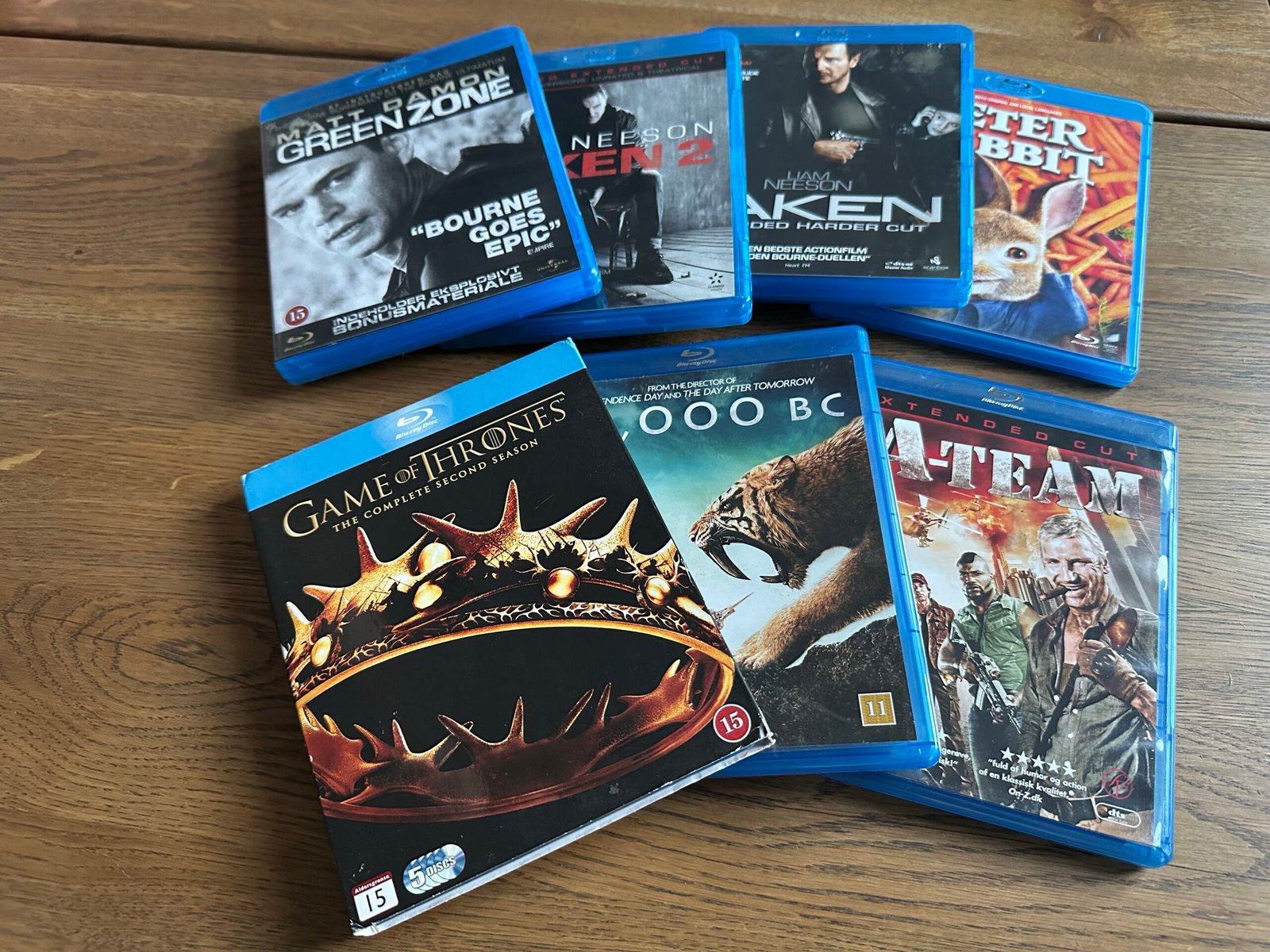
Recently, I bought these 7 used Blu-rays for around $3 each.
That is the kind of purchase that makes physical media feel realistic again. Not luxury collecting. Not limited editions. Not expensive imported box sets. Just affordable used movies that I can own.
For less than the cost of some monthly subscriptions, I added actual films to my own collection.
And that is the point.
Buying Blu-rays again does not have to mean spending a fortune. It can start small. A few used discs. A shelf. Some movies you already love. Maybe a few you missed.
There is no need to turn it into an expensive hobby from day one.
DVD Still Has a Place
It is easy to talk about Blu-ray and 4K Blu-ray and forget DVD.
But DVD still matters, especially for beginners and budget collectors.
DVDs are often very cheap. They are easy to find used. Many people already have them at home. Some films are still easier to find on DVD than on Blu-ray, especially older titles, niche releases, documentaries or children’s movies.
Of course, DVD does not offer the same picture quality as Blu-ray or 4K Blu-ray. On a large modern TV, the difference can be obvious.
But ownership is not only about the highest possible quality. It is also about access, affordability and keeping what matters.
A good physical media collection can include DVD, Blu-ray and 4K Blu-ray. They do not have to compete. They can serve different purposes.
For example, the other day I wanted to watch “The Mummy” from 1999, but I couldn’t find it on any streaming services I subscribe to. But then I remembered I still own it on DVD. I was actually surpriced by how good it looked. It’s not Blu-Ray quality, of course, but it looked much better than I remembered.
DVD can be the cheap entry point.
Blu-ray can be the everyday sweet spot.
4K Blu-ray can be for the movies where quality really matters.
That feels like a practical approach to me.
The Quality Argument Is Real
One reason people come back to physical media is ownership.
Another is quality.
Streaming can look very good, especially with a strong internet connection and a good TV. But streaming is still compressed and dependent on bandwidth, app quality, service settings and platform decisions.
Blu-ray and especially 4K Blu-ray can offer a more consistent experience. Higher bitrates, better audio options and fewer surprises.
I do not think every movie needs to be owned in the best possible format. That would get expensive quickly. But for favorite films, big visual movies, classics, sci-fi, action, animation or anything with great sound design, physical media can make a real difference.
It is not just nostalgia. There are practical reasons why discs still matter.
You know what version you have.
You know it will play without buffering.
You know it is not leaving a platform next month.
You know you can lend it, resell it or keep it.
That combination of quality and control is powerful.
Physical Media Can Be the Start of a Local Media Library
For me, the interesting part is not only buying discs again.
It is what physical media can become when combined with a local media library.
That is where things like Plex, Jellyfin, NAS storage and home media servers become interesting.
A Blu-ray on a shelf is already useful. You can put it in a player and watch it.
But a local media library takes the ownership idea further. It gives you the possibility of organizing your own movies, browsing your own collection, and streaming your own media at home without relying completely on outside services.
That is the direction I am interested in.
Not because everyone needs a complicated home server. Most people do not. But because there is a strong idea behind it:
What if your favorite movies, shows, music, photos and documents lived in your own vault?
Not scattered across subscriptions.
Not locked behind accounts.
Not dependent on a platform changing its mind.
Stored locally. Organized properly. Backed up. Owned by you.
That is the bigger EddaVault idea.
Home Media Servers and NAS Make Ownership More Convenient
One reason streaming became so popular is that it solved a real problem: convenience.
Physical media can feel less convenient. You need the disc. You need a player. You need shelf space. You may need to remember where things are.
A home media server can help bridge that gap.
Plex and Jellyfin are two common options for organizing and streaming your own media library. A NAS can store the files. A mini PC or server can handle playback. Your TV, phone, tablet or computer can become the front end.
This is where physical ownership and digital convenience meet.
You can own the disc and still enjoy a streaming-like experience at home.
That is not the first step for everyone. If you are just starting out, the first step might simply be buying a few used Blu-rays and watching them on a standard player.
But long term, I think many people will want both:
Physical media for ownership.
Local media servers for convenience.
That is the space EddaVault will explore.
I Am Not Fully Anti-Streaming
It would be easy to turn this into a “streaming is bad, discs are good” argument.
But I do not think that is honest.
Streaming still has a place.
It is great for discovering new things. It is useful for casual viewing. It is convenient for kids, family use and content you do not care enough to own. Sometimes it is the easiest option.
The problem is not streaming itself.
The problem is relying on streaming for everything.
When every movie, show, song, photo, document and memory depends on someone else’s platform, we lose control. Maybe slowly. Maybe quietly. But we lose it.
So my goal is not to cancel everything and pretend streaming never existed.
My goal is to be more intentional.
Stream what makes sense.
Buy what matters.
Build a collection over time.
Keep the things worth keeping.
That feels more balanced than going fully in either direction.
Start Small: You Do Not Need a Perfect Collection
If you are thinking about buying physical media again, my advice is simple: start small.
Do not begin with a giant wishlist or expensive collector editions.
Look for used Blu-rays. Check local shops, online marketplaces, charity shops, second-hand stores or sales. Start with movies you already know you like.
A good first goal could be 10 films you would be happy to watch again.
Not the most impressive collection.
Not the rarest editions.
Not what people on YouTube say you need.
Just movies that matter to you.
That is enough.
From there, you can decide what kind of collection you want. Maybe you focus on Blu-rays. Maybe you keep buying cheap DVDs. Maybe you upgrade selected favorites to 4K Blu-ray. Maybe you eventually build a Plex or Jellyfin server.
The important thing is that you are building something you own.
Why This Matters Beyond Movies
EddaVault starts with movies and physical media, but the bigger idea goes beyond Blu-ray.
The same question applies to music, photos, documents, backups and personal data:
Do you own it?
Can you access it without a subscription?
Is it backed up?
Is it organized?
Will it still be there in ten years?
Movies are a good place to begin because the problem is easy to see. We pay for streaming, but the library keeps changing. We buy digital movies, but they are often tied to accounts and platforms. We assume access will always be there, but we do not fully control it.
Physical media is a reminder that ownership still matters.
And once you start thinking that way, it becomes difficult to stop at movies.
Final Thoughts
I started buying Blu-rays again because I was tired of paying for access without ownership.
Not because streaming is useless.
Not because every movie needs to be on a shelf.
Not because physical media is perfect.
But because owning the things that matter feels better than renting everything forever.
Those 7 used Blu-rays for around $3 each were not a huge purchase. But they represented a shift. A small step back toward building a personal library instead of only feeding another subscription.
That is what EddaVault is about.
This is exactly what EddaVault is about. Over the coming months, I’ll be sharing everything I learn about physical media, home media servers, media server software, NAS storage, ripping, backups, and building a media library that you actually own. Whether you’re buying your first used Blu-ray or planning a complete home media server, I hope you’ll find something useful here.
We’re all at different stages of the journey, but if you’re looking to take back ownership of your entertainment, you’re in the right place.
Taking back ownership slowly, practically and without hype.
Start with one shelf.
Start with a few used Blu-rays.
Start with the DVDs you already have.
Start with the movies you care about.
You do not need to own everything.
But maybe it is time to own what matters.